Hard Core Community


When Jack Senff - former frontman of the now-defunct emo/skramz band, William Bonney - would scream the lyrics to songs like "Drug Lord" or "See Ya Later," he'd do so facing the same direction as the crowd. This unique approach to live music performance blurred the lines between the audience and the band; they were, in effect, all one organism, possessed by an unspeakable catharsis. 

"The crowd would sort of become part of the band," Senff Remarked in a YouTube interview. "There were no barriers. It's not like we played stages; we played living rooms and basements and stuff..." 

You might not particularly care for the caustic riffs and yearning screams that typify William Bonney's distinctive sound, but anyone would appreciate the remarkable collective displays of midwestern angst and sweat as seen in this live video. 


Senff, in his classic 3/4 sleeve baseball shirt, screams his heart out into the mic. The concentrated energy in the room is almost biblical. 

This was in South Bend, Indiana in 2013. I watched this from my parent's apartment in Brooklyn, envious of these kids' tight-knit emo community. I think it existed in Brooklyn at the time. Maybe a bit in Bushwick, I don't know. But, man did I wish I was in that sweaty venue with all of them, screaming until my throat was sore. 

To be integrated into a little community like that is an incredible feeling. I know because I've had little tastes of it throughout the years. 

We all need some outlet like this: somewhere where there's no judgement and friends abound. 

Read my latest!

 By Frank Filocomo

ICYMI: I had an article go up in Front Porch Republic last week. 

Read it here. 

I write about one Florida-native's quest to unearth her hometown's "third places." 

Have an idea of what my next article should be? Leave a comment!

Wishing you all a productive week!

The Communitarian Nature of School Uniforms


I hated the uniforms we had to wear in grade school. 

In my middle school in Bay Ridge, Brooklyn, we were made to wear beige khaki pants and a collared shirt adorned with the school's logo. Deviation from this would result in a call home. 

I was something of a defiant little brat. I listened to death metal, skateboarded (though not well), and thought rules were bullshit. The uniforms, I felt, suppressed my totally unique individuality. 

It wasn't until much later that I started to see the communitarian merit in the common school uniform. 

Brandon McNeice, in a must-read piece for Front Porch Republic, makes the case for school uniforms as social-levelers:
Uniforms reject the idea that a child’s worth is measured by what she wears, what she can afford, or how effectively she can perform her identity.

Thus, the uniform connotes a sense of togetherness. 

You'll often find in everyday life the individualist temptation to engage in conspicuous consumption. That is, the materialistic desire to show off ones wealth with gaudy, outward displays. Someone wearing a Rolex watch, for example, wants people to know that they come from affluence. 

When, however, we all dress similarly, devoid of designer brands and lavish embellishments, the social dynamic is effectively leveled. Thus, personality and individualism must be demonstrated through intellectual merit. 

Read McNeice's article here. 

Speaking of Front Porch Republic, I should have an article coming out there in the coming days.

Stay tuned!

Laura Loomer's Idiotic War on the Office of the Surgeon General


Laura Loomer - the performative Right-wing political provocateur, notorious for her abrasive demeanor and pugnacity - is, at least in part, to blame for the country's lack of a surgeon general. 

She has, in effect, become the MAGAsphere's gatekeeper. 

Trump's first nominee to the surgeon general post, Dr. Janette Nesheiwat, was routinely lambasted by Loomer on X:
Make no mistake, Loomer's main contention with Nesheiwat likely had less to do with this medical malpractice case than it had to do with her "promotion of DEI-focused initiatives implemented through City M.D., and her advocacy for the China Virus 'vaccine' as recently as November 2024."

President Trump, just days after this post, withdrew Nesheiwat's nomination.

To Loomer, Nesheiwat just wasn't MAHA enough. 

Loomer's response to Trump's withdrawal of the Fox News personality's nomination:
Really classy...

In place of Nesheiwat, Trump nominated MAHA-advocate and author, Dr. Casey Means, whom HHS Secretary RFK Jr. has praised: “We actually have to figure out new approaches to medicine, and that’s the kind of leadership that she’s going to bring to our country.”

Means' crunchy con-ism, however, still wasn't enough to satiate Loomer's intractable MAGA appetite: 
Loomer continues to relentlessly attack Means. 

Now we're in August of 2025, and we still don't have a surgeon general. 

What's more, we don't even have a set date for Means' Senate confirmation hearing. According to Politico, "The Senate Health, Education, Labor and Pensions Committee is still waiting on paperwork to consider Dr. Casey Means' surgeon general nomination..."

So what if we don't have a surgeon general?

Surgeon generals, through their advisory reports, launch, what the late-Amitai Etzioni called, "national dialogues," or "megalogues." These are community- and country-wide conversations that, if executed correctly, can "lead to significant changes in core values." 

Case in point: it wasn't until Dr. Vivek Murthy's 2023 report, Our Epidemic of Loneliness and Isolation, that we began to take the loneliness epidemic seriously. 

Murthy, however, left the Office of the Surgeon General (OSG) in January of 2025. Since then, Loomer's gatekeeping has prevented the position from being filled. 

President Trump mustn't kowtow to Loomer; our nation needs a doctor.  


Dispelling a Myth About Communitarians


Communitarians do not believe in coercion. 

Some, often in the libertarian or individualist camps, will use the term communitarian as a pejorative, that is, a dig against those whom they deem to have authoritarian or collectivistic tendencies. 

This, however, couldn't be further from the truth. 

Communitarians do not believe in a top-down, police state. Nor do they think authoritarianism should supplant democracy. Rather, they are respectful of rights and individual autonomy, while also being cognizant of the need for a robust social fabric. 

The great Amitai Etzioni in his book, The New Golden Rule, makes the case that communitarianism essentially represents a balance between bounded individualism and social order. 

To be in favor of social order, however, does not mean that you subscribe to social conservatism or other ideologies that seek to police private behavior.

Etzioni writes:
One cardinal difference between the social conservative and the communitarian paradigm advanced here is the standing of autonomy. It is basic to the communitarian paradigm; it is secondary or derivative in social conservative paradigms. 

It's certainly true that communitarians - myself included - believe that American society has drifted too far into a me-centric paradigm, but they do not think there should be an over-correction. 

If, for example, America's neoliberal era is succeeded by an age of illiberalism and police states, we'll know that the pendulum has swung too far in the other direction. 

The unbounded liberalism of late-18th century France and the authoritarianism of Mao's China are both bad. 

"A good society," writes Etzioni, "requires a balance between autonomy and order." 

Very well. Now that we've dispelled that misnomer, let's have an awesome week!

What Does Post-Liberalism Look Like?


What is post-liberalism, and what does it look like in practice?

Last week, Oren Cass - founder of American Compass, a new think tank that promotes the economic policies of the New Right - sat down with Notre Dame political science professor and author of Why Liberalism Failed, Patrick Deneen, to discuss the future of post-liberalism, a nascent ideology with an unclear definition. 

Deneen started by defining liberalism. 

These are the four ideological pillars he articulated:

1. Open borders, or, the free movement of peoples. 

2. Laissez faire economics.

3. The belief that liberal democracy ought to be disseminated widely (i.e. the Fukuyama thesis). 

4. The legacy of the sexual revolution. 

Phillip Blond, post-liberal political theorist and author of Red Tory, often alludes to point 2 and 4 as encapsulating the Left-Right liberal paradigm. That is, conservatives (especially in the American context, though less so these days), extol the virtues of deregulation and free markets, while liberals promote a sort of individual autonomy, particularly concerning sexual expression and the jettisoning of gender norms. According to Blond, both belief systems are actually two sides of the same liberal coin. 

Blond, an Englishman, articulated this paradigm at an Institute of Art and Ideas event in 2019:
We have been governed by extreme liberalism since the time of Margaret Thatcher. We have extreme economic liberalism on the Right, and extreme social liberalism on the Left, and they're a common project, and I always think it's incoherent to hear people on the Left denouncing neoliberalism economically, but essentially upholding it socially, and vice versa. 
This same sentiment can be found in Compact Magazine's mission statement: 
Our editorial choices are shaped by our desire for a strong social-democratic state that defends community—local and national, familial and religious—against a libertine left and a libertarian right.
Weirdly, though, it appears that Compact has since changed that language on the 'About' section of their site. See here. 

Deneen, like Blond and the folks at Compact, argues that the "limitlessness" of unbounded liberalism - that is, the belief that individuals should be left to their own devices in all realms of life - does, in fact, have limits. 

Both Deneen and Cass believe that we are already seeing the germ of a reaction to liberalism, as described in the aforementioned four pillars.  

That much is pretty hard to dispute. The Bernie movement, as well as MAGA, are both pretty obvious reactions to the liberal order. New York assemblyman and probable next mayor of New York City, Zohran Mamdani, represents a far-Left rejection of liberalism. 

We are, it certainly appears, entering into a post-liberal era. This, though, begs two stubborn questions: 1. We know what post-liberalism is against, but what is it for? 2. What would post-liberalism look like in practice?

While Cass asked Deneen several times what a "positive version" of post-liberalism might look like, Deneen struggled to offer anything concrete, reiterating that people today are disaffected by liberalism. At one point, he attempts to make a parallel between post-liberalism and libertarianism. This was totally mystifying, as the former is frequently described as a critique of the latter. 

To be sure, Deneen is brilliant. Why Liberalism Failed was an awesome contribution to the national conversation. His normative view of a post-liberal future, though, at least as articulated in this podcast, is underwhelming. 

Personally, I struggle to see any kind of real difference between post-liberalism and social conservatism, Ã  la Rick Santorum. 

Thus, it would make far more sense for post-liberals to simply advocate for a return to social conservative thinking, instead of attempting to build an entirely new ideology from the ground up. 

So, what is post-liberalism? As of right now, nothing...

But, perhaps I'm missing something. If you have the time, listen to the podcast here. I'd love to hear your thoughts!

As always, have a great week!

Conversation Is the Only Way Forward


There is nothing more dangerous than an ideological echo chamber. 

In Reclaiming Conversation, Sherry Turkle urges readers to "talk with people whom you don't agree."

This is, of course, easier said than done. 

What if, for instance, the person with whom you are conversing is a holocaust-denier or, at least, a holocaust-skeptic? Should said person even be entertained?

A few weeks ago, former UFC fighter and far-right political provocateur, Jake Shields, sat down with X-user and pro-Israel advocate, Adam King, who goes by the pseudonym, Awesome Jew, online.  

Shields is, in many ways, a rebarbative figure. 

He is obsessed with, what has historically been referred to as, the Jewish Question, or, the JQ. That is, more or less, the rather myopic and derivative view that Jews run the world. This is nothing new: an old and boring form of bigotry. 

While some discern anti-Zionism and antisemitism, Shields doesn't bother. 

Here's Shields playing Ye's "Heil Hitler" in front of Israelis in a hotel lobby. "Fuck these Israelis,"  Shields says in his raspy voice, "they're fucking everywhere." 

To rehash every dimwitted, Jew-hating X post from Jake Shields would be akin to emptying the ocean with a thimble, as his feed is replete with the typical Leo Frank-type tropes. 

This said, I was shocked to see that Shields had accepted a debate challenge from Awesome Jew, a right-wing Zionist. 

You can watch the nearly-three hour debate here. 

To be clear, I am no fan of Awesome Jew, either. Many of his posts are far from thoughtful. But his knowledge of Israel and the conflict in the region writ large was clearly no match for Shields, a neophyte far out of his depth. 

Content aside, though, the exchange was surprisingly civil.  

In fact, it was less of a debate and more of friendly back-and-forth, with plenty of laughter and tongue in cheek one-liners. 

While you can frame this as a showdown between a holocaust-skeptic and a right-wing Zionist, you can just as easily see it as two stripped-down humans seeing each other as equals, instead of enemies. 

To be sure, there are some folks in the ever-growing world of nasty conspiracy theories whom it would be unwise to engage: Stew Peters and Lucas Gage are just a few examples. They don't just espouse racism and antisemitism, they engage in violent rhetoric. Here is Peters calling for a "Final Solution" on the Jewish people. 

Shields, however, to his credit, does not advocate for violence during his debate with King (a low bar, I know).

The point: conversation, not censorship, is the best way to combat extremism, both on the political Right and Left. 

Jake Shields and Adam King (Awesome Jew) shake hands.

To be sure, not everyone has the stomach to engage with such divisive personalities, and that's totally understandable. But someone has to do it. 

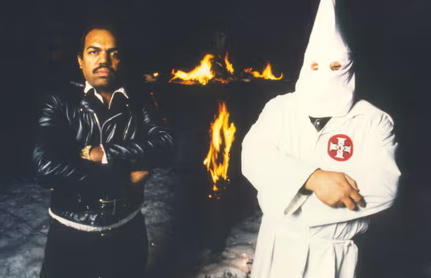
I'm reminded of Daryl Davis, a black man who has, through the power of conversation, de-radicalized members of the KKK. Davis, a remarkably affable guy with no motive other than cognitive empathy, has done more to combat extremism than anyone else. His approach and temperament ought to be studied. 

Daryl Davis with KKK member.

As polarized as we are in America today, I remain optimistic about our future. Through dialectic, we can depolarize, deradicalize, and come together once again. 

A TikToker Asks, 'Can It Third Place?'

By Frank Filocomo

TikTok is a mostly brain-numbing app, typified by vapid Get Ready With Me (GRWM) videos, your typical celebrity gossip click-bait, and some confoundingly nonsensical political takes (recall when TikTok influencers were taking to the platform to praise Osama bin Laden for his repulsive Letter to the American People?) 

The app - again, mostly a toxic, digital wasteland - will turn you into a proper misanthrope. 

User @madisonraetogo, however, is one exception to the rule. 

Madison, in a TikTok-original series she calls "Can It Third Space?" travels around the U.S. to find venues that more or less fit Ray Oldenburg's definition of a "Third Place." 

In The Great Good Place, Oldenburg writes that a third place is...

a generic designation for a great variety of public places that host the regular, voluntary, informal, and happily anticipated gatherings of individuals beyond the realms of home and work. 

Madison has her own variation of the Oldenburg criteria for a third space:

1. "It has to be free entry;

2. we have to meet someone;

3. vibes."

While these criteria for third places don't match up exactly with Oldenburg's (Oldenburg mentions low-barrier to entry, not necessarily free entry; he emphasizes the informality of these places and their conduciveness to conversation; the concept of social leveling is extremely important; etc...), it's close enough.

Madison takes us to Washington Square Park in NYC, and cafes and art museums throughout Florida. 

After spending some time in these places - and making some valiant effort to socialize with total strangers - she employs a 1-10 rating system. 

Her comments throughout these videos are thoughtful, witty, and perceptive. A much welcomed respite from the cacophony of nonsense on TikTok, for sure. 

Many people I speak to about this subject lament what they perceive to be the decline in America's social capital and civil society. I, too, share that same lament. The good news, though, is that people - young people, in particular - are yearning for community and social connection in a world of uprootedness and atomization. 

Robert Putnam must be taking solace in the fact that young people today no longer want to bowl alone. 


The Old 'Young Guns'


In March, Troy Olson and I had a conversation about the dying Neoliberal Order and communitarianism on the political Left and Right. Watch a clip below!


Whatcha Reading?


ICYMI: I wrote about Reading Rhythms, a NYC-based literary group, for Front Porch Republic, easily one of my favorite online publications. 

From the article:

Though some folks were understandably timid at first, a wave of loquacity hit the room during our conversation time; everyone wanted to discuss what they had been reading. I even saw some people exchanging phone numbers and inquiring about the next event.

To sum up my thesis: reading does not necessarily have to be a solitary act; it can, in fact, be surprisingly communal, if done in the right context. 

I also encourage you to read Nadya Williams' piece about a more communitarian kind of reading here.  

By the way, I'm curious: what are you reading right now? Tell me in Frank's Forum, here. 

I recently started Coming Apart by Charles Murray, and I can already tell why it's such an important book...

Have a great week!

The Thing About Artists

By Claire Cordonnier

You’ve probably had the satisfying experience of listening to a pop song and resonating with the lyrics. 

It’s comforting to know that you aren’t alone in your feelings. But what about for the artist? What's scary about sharing your art with people is that you are sharing with them something deeply personal. Good art is drawn from life and expresses something authentic and unique to you.


Good artists need to have “life” to draw from. They need to have had life experiences that have challenged and changed them emotionally.


What separates artists from other people? Do they have more interesting lives than the average person? Or do they feel emotions more strongly than other people in a way that compels them to express them?


In expressing their emotions, artists allow themselves to be vulnerable in a way that resonates with their audience.  I would argue that this kind of vulnerability doesn’t exist the same way in other fields in which the answer is more “objective.”


But what about the scientists and engineers that work in these "objective" fields? Don’t they feel the same need to express themselves? Perhaps their work allows them to cope with their emotions in a more indirect way.

Frank's Latest on X

Read my latest in @GivingReview ! https://t.co/UHGd1htrPx — Frank Filocomo (@FilocomoFrank) Oct 28, 2026 October 28, 2026 at 09:...